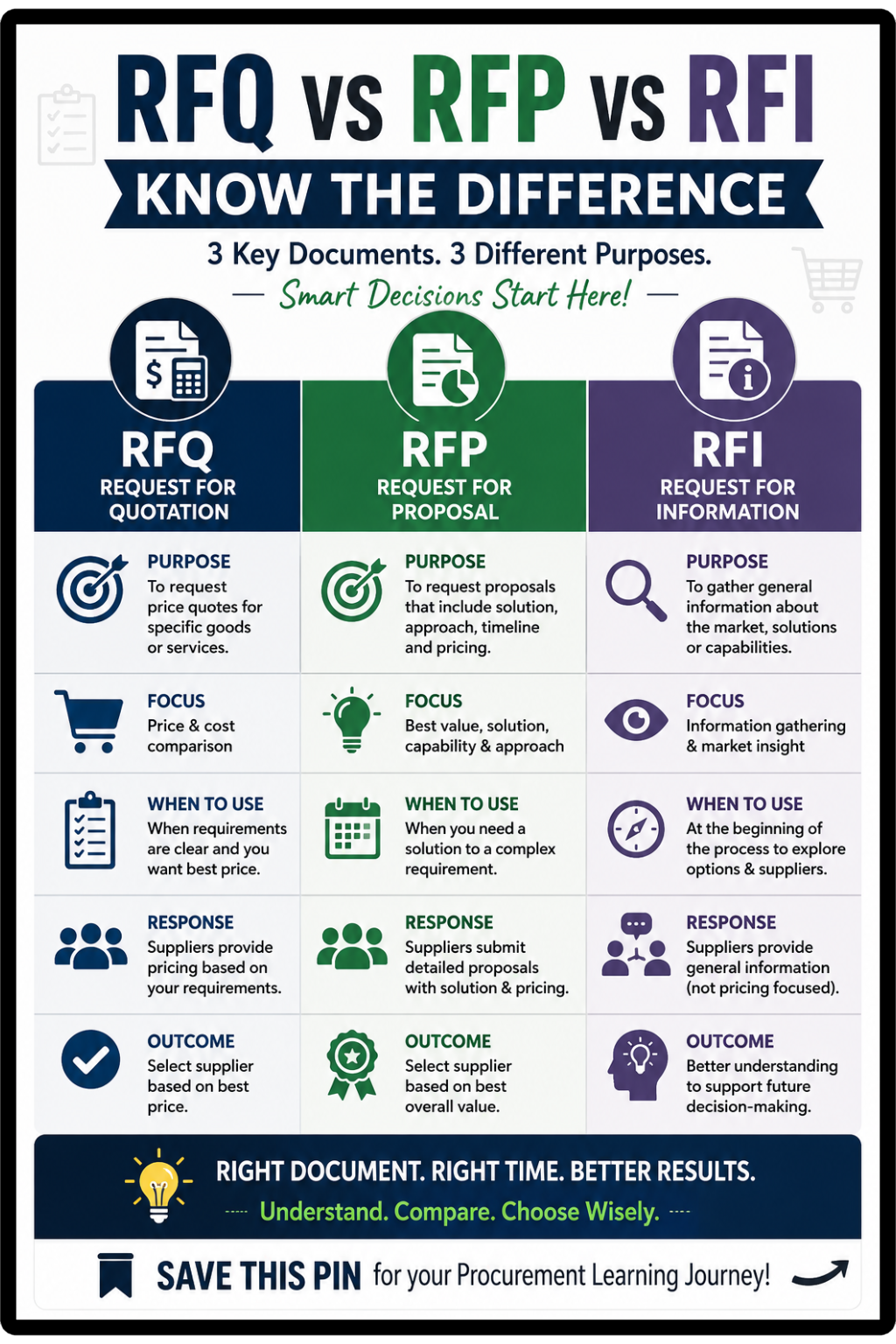
Whether you’re a procurement professional, sourcing manager, supply chain analyst, or business owner, you’ve likely encountered the terms RFI, RFP, and RFQ. While they are often used interchangeably, they serve very different purposes within the procurement lifecycle.
Choosing the wrong document can lead to:
- Delayed projects
- Poor supplier selection
- Increased procurement costs
- Unclear requirements
- Contract risks
This comprehensive guide explains RFQ vs RFI vs RFP, when to use each document, real-life examples, comparison charts, procurement flow diagrams, FAQs, and best practices.
What is an RFI (Request for Information)?
A Request for Information (RFI) is the first stage of supplier engagement.
Its purpose is to collect information from potential suppliers before defining procurement requirements.
Think of an RFI as market research.
Objectives
- Understand supplier capabilities
- Learn about available technologies
- Explore market trends
- Identify potential vendors
- Gather preliminary pricing insights
Typical RFI Questions
- Company profile
- Years in business
- Manufacturing locations
- Certifications
- Major customers
- Production capacity
- Sustainability practices
- Technology capabilities
Example
A retail company wants to automate its warehouses but doesn’t know which automation technologies exist.
Instead of requesting prices immediately, they send an RFI to multiple automation companies asking about:
- Robotics
- Conveyor systems
- AI software
- Implementation timelines
- Case studies
No pricing negotiation happens yet.
What is an RFP (Request for Proposal)?
A Request for Proposal (RFP) is issued when the buyer understands the business problem but wants suppliers to recommend the best solution.
Price is important—but it is not the only deciding factor.
Suppliers submit detailed proposals explaining:
- Technical solution
- Methodology
- Team
- Timeline
- Project plan
- Commercial proposal
Typical RFP Evaluation Criteria
| Criteria | Weight |
|---|---|
| Technical Capability | 35% |
| Experience | 20% |
| Commercial Offer | 20% |
| Project Timeline | 15% |
| Innovation | 10% |
Example
A hospital wants a complete ERP system.
Different vendors may offer:
- SAP
- Oracle
- Microsoft Dynamics
- Custom ERP
The hospital needs the best solution, not simply the cheapest price.
Therefore, an RFP is appropriate.
What is an RFQ (Request for Quotation)?
An RFQ is used when the buyer knows exactly what needs to be purchased.
Specifications are fixed.
The primary objective is obtaining the best price.
RFQ Usually Includes
- Product specifications
- Quantity
- Delivery location
- Delivery timeline
- Payment terms
- Warranty requirements
- Incoterms
- Commercial terms
Example
A company needs:
- 500 office chairs
- Black color
- Ergonomic design
- Same specifications
Multiple suppliers can supply identical products.
The company simply compares:
- Unit price
- Delivery
- Payment terms
The lowest compliant bidder generally wins.
Procurement Flow: Where RFI, RFP & RFQ Fit
Business Need │ ▼Market Research │ ▼ RFI │ ▼Requirement Definition │ ▼ RFP │ ▼Technical Evaluation │ ▼Final Specifications │ ▼ RFQ │ ▼Price Comparison │ ▼Supplier Selection │ ▼Purchase Order
Decision Tree
Do you know what you need? │ ┌────┴─────┐ │ │ NO YES │ │Need supplier Need solution?knowledge? │ │ ┌──┴──┐ │ │ │ YES YES NO │ │ │ RFI RFP RFQ
RFQ vs RFI vs RFP Comparison
| Feature | RFI | RFP | RFQ |
|---|---|---|---|
| Purpose | Collect Information | Find Best Solution | Obtain Best Price |
| Stage | Early | Middle | Final |
| Pricing | Optional | Included | Mandatory |
| Technical Proposal | No | Yes | Limited |
| Supplier Creativity | High | High | Low |
| Negotiation | Minimal | Moderate | High |
| Selection Basis | Capability | Overall Value | Price |
| Complexity | Low | High | Low |
| Time Required | Short | Long | Medium |
Procurement Lifecycle
Spend Analysis │Supplier Research │ ▼ RFI │Requirement Finalization │ ▼ RFP │Technical Evaluation │Commercial Negotiation │ ▼ RFQ │Award Contract │Supplier Performance
Real Procurement Example
Imagine a company building 100 new warehouses.
Step 1
The procurement team doesn’t know which cold room technologies are available.
They issue an RFI.
Suppliers explain:
- Energy-efficient systems
- Refrigerants
- Automation
- Installation process
Step 2
The company now understands available technologies.
They issue an RFP requesting:
- Complete engineering solution
- Layout
- Power consumption
- Maintenance
- Warranty
Step 3
After selecting one design, detailed specifications are fixed.
Now suppliers receive an RFQ asking only for pricing.
Advantages of RFI
✔ Understand supplier landscape
✔ Learn new technologies
✔ Reduce procurement risk
✔ Improve specifications
✔ Expand supplier base
Advantages of RFP
✔ Better technical evaluation
✔ Encourages innovation
✔ Compares complete solutions
✔ Reduces implementation failures
✔ Enables value-based sourcing
Advantages of RFQ
✔ Faster procurement
✔ Easy price comparison
✔ Standardized evaluation
✔ Better negotiation
✔ Cost savings
Disadvantages
RFI
- No binding quotation
- No price commitment
- Time-consuming if sent to too many suppliers
RFP
- Long evaluation cycle
- Complex documentation
- Higher administrative effort
RFQ
- Limited innovation
- Only suitable when specifications are fixed
- Lowest price may not always mean best value
Evaluation Matrix
| Parameter | RFI | RFP | RFQ |
|---|---|---|---|
| Supplier Experience | ⭐⭐⭐⭐⭐ | ⭐⭐⭐⭐ | ⭐⭐ |
| Technical Capability | ⭐⭐⭐⭐⭐ | ⭐⭐⭐⭐⭐ | ⭐ |
| Pricing | ⭐ | ⭐⭐⭐ | ⭐⭐⭐⭐⭐ |
| Innovation | ⭐⭐⭐⭐⭐ | ⭐⭐⭐⭐ | ⭐ |
| Delivery | ⭐⭐ | ⭐⭐⭐ | ⭐⭐⭐⭐⭐ |
Typical Documents Included
RFI
- Company profile
- Capability questionnaire
- Product catalogue
- Certifications
- Manufacturing locations
RFP
- Scope of work
- Project objectives
- Technical requirements
- Evaluation criteria
- Timeline
- Budget
- Proposal format
RFQ
- BOQ
- Technical specifications
- Commercial terms
- Delivery schedule
- Payment terms
- Tax details
- Incoterms
Common Industries Using RFI, RFP & RFQ
| Industry | RFI | RFP | RFQ |
|---|---|---|---|
| Manufacturing | ✔ | ✔ | ✔ |
| Construction | ✔ | ✔ | ✔ |
| IT | ✔ | ✔ | ✔ |
| Healthcare | ✔ | ✔ | ✔ |
| Retail | ✔ | ✔ | ✔ |
| FMCG | ✔ | ✔ | ✔ |
| Government | ✔ | ✔ | ✔ |
Best Practices
For RFI
- Keep questions concise.
- Avoid asking for pricing.
- Focus on capabilities and experience.
- Use responses to refine requirements.
For RFP
- Define evaluation criteria in advance.
- Include business objectives.
- Encourage innovative solutions.
- Establish a transparent scoring process.
For RFQ
- Provide complete specifications.
- Send to qualified suppliers only.
- Compare total cost of ownership, not just unit price.
- Clarify commercial terms before awarding.
Common Mistakes to Avoid
❌ Sending an RFQ before requirements are finalized.
❌ Using an RFP for commodity purchases.
❌ Requesting detailed proposals when only pricing is needed.
❌ Evaluating suppliers solely on the lowest price.
❌ Ignoring supplier capability during strategic sourcing.
Frequently Asked Questions (FAQs)
1. Which comes first: RFI, RFP, or RFQ?
Typically, the sequence is RFI → RFP → RFQ, although not every procurement project requires all three.
2. Can I skip the RFI?
Yes. If you already understand the supplier market and available solutions, you can move directly to an RFP or RFQ.
3. Is RFQ only for products?
No. RFQs can also be used for standardized services with clearly defined scopes, such as transportation, maintenance, or staffing.
4. Is RFP always more expensive?
Not necessarily. While the process takes longer, it often results in better long-term value by identifying the most suitable solution.
5. Which document is best for strategic sourcing?
A strategic sourcing project often uses RFI to explore the market, RFP to evaluate solutions, and RFQ to finalize commercial negotiations.
Key Takeaways
| Situation | Recommended Document |
|---|---|
| Need market intelligence | RFI |
| Need suppliers to propose solutions | RFP |
| Need competitive pricing for defined requirements | RFQ |
Simple Rule to Remember:
- RFI = Learn
- RFP = Solve
- RFQ = Buy
Conclusion
Understanding the differences between RFQ, RFI, and RFP is essential for building an efficient procurement process. Each document serves a distinct purpose—whether you’re exploring the market, evaluating solutions, or negotiating the best price. By selecting the right approach at the right stage, organizations can reduce procurement risks, improve supplier selection, and achieve better value for money.
Leave a Reply